A personal reflection on Muzaffar Ali’s unforgettable film Gaman
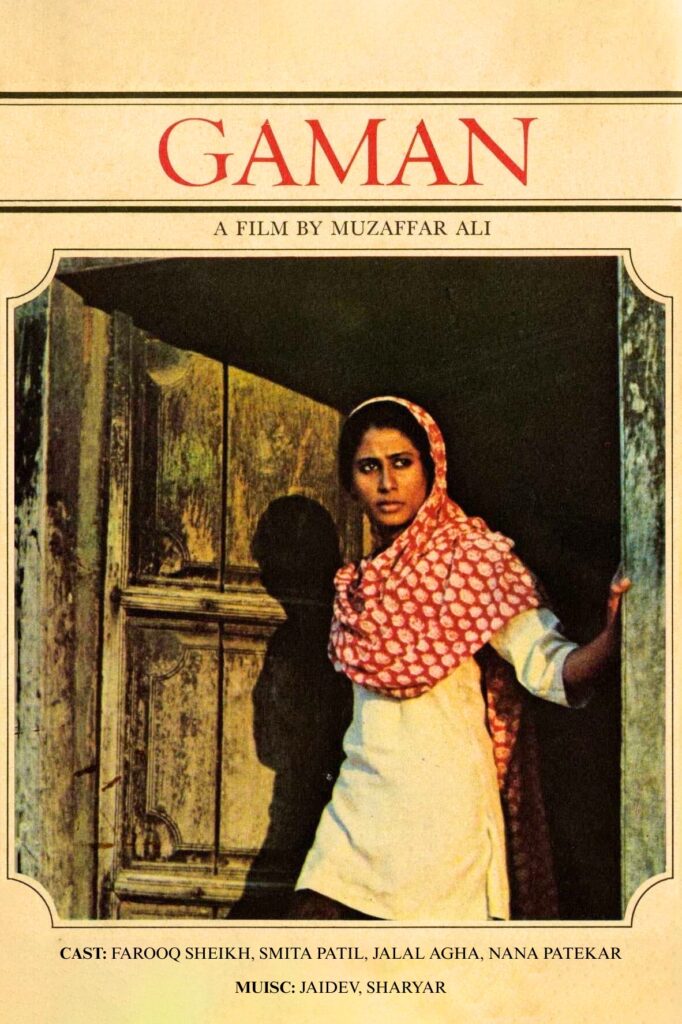
The famous English idiom “You can’t go home again”, coined by Thomas Wolfe in his 1940 novel You Can’t Go Home Again, finds a haunting cinematic echo in Gaman, the debut film of Muzaffar Ali, released in 1978.
That period was nothing short of a renaissance in Hindi cinema. Parallel cinema had become the new buzzword. A fresh generation of writers, directors, and actors was slowly carving out a respectable space within the deeply entrenched establishment of Bollywood. In that atmosphere, Gaman emerged as a quiet yet powerful trendsetter of the new-age Indian film.
For me personally, 1978 was also a time of intellectual pretensions, the age when one wished to be seen as belonging to the world of art and fine arts, often without fully comprehending the difference between art for art’s sake and art for life’s sake. Because of that phase, I have always been aware of the iconic influence of this film, even before I truly understood it.
Migration as Destiny, Not Choice
Muzaffar Ali’s context and objective were clear: to explore and document the great migration that had been happening for decades, from the interiors of the Hindi heartland to Mumbai. In those days, Mumbai was almost the equivalent of the Wild West of America, a place where people arrived with hope, desperation, and no certainty of return.
Gaman records the pain and inevitability of uprooting, the struggle to find a place in a new ecosystem, the cultural dislocation, the slow erosion of identity, and the quiet frustrations of survival.
And the journey seems to end at the gate of Bombay VT station, with the unspoken realization:
“You can’t go home again.”
The film never shouts this line, it simply lets life prove it.
Not Craftsmanship; But Life Itself
When I sat down to watch the film with Nagpur Film Club, my intention was to observe the finer aspects of filmmaking craft, knowing that the director was the legendary Muzaffar Ali.
But within the first 10-15 minutes, it becomes clear that this is not a film of visible craftsmanship.
It is a film of raw observation.
Of events as they happen.
Of places as they exist.
Of people as they suffer.
The camera does not decorate reality, it witnesses it.
The Village – Intense, Intimate, Unforgettable
In the village, which is the source of migration, the filming is extraordinarily intense.
The camera captures minute details, remaining confined within the household, dealing with only a few characters. The canvas is small, but emotionally overwhelming.
Not surprisingly, Smita Patil’s presence emerges with tremendous strength, even in silence.
Her eyes carry entire conversations.
Even the mother’s character speaks more through her gaze than through words.
The Moharram procession sequence is executed with rare sensitivity, not as a display of religious identity, not as a symbolic “Ganga-Jamuni tehzeeb” cliché, but as a natural part of lived reality.
I was particularly delighted that Thakur Sahab appears only briefly.
The director touches the character and moves on, refusing the stereotype of turning him into a central villain.
That restraint itself shows the honesty of the writing.
Interestingly, Muzaffar Ali creates a parallel later in Mumbai, but there the camera moves faster, as if suggesting that the social fabric in the city is thinner, more superficial, lacking the depth of the village.
Mumbai: A City That Never Belongs to You
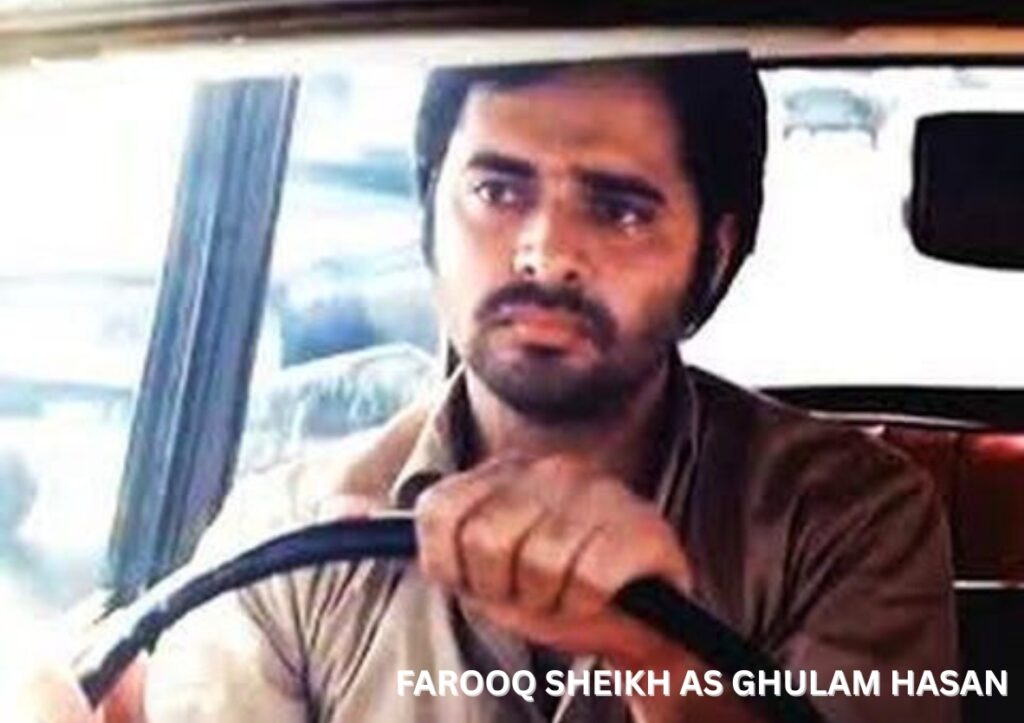
Once the film shifts to Mumbai, the characters themselves become vague.
They drift with circumstances rather than shaping them.
Here the director deliberately opens the canvas wide.
Very wide.
He shows everything, yet refuses to focus on any one thing.
It feels as if the writer is now telling another story altogether –
the biographical sketch of the eternally migratory city itself: Mumbai.
The camera moves through the city with a strange distance, almost a haze by design.
We are taken to the Taj, to the red-light district, to Chowpatty, to taxi stands, to crowded streets, to anonymous rooms, to nameless faces.
Even the unforgettable character of Yashodara’s father, ‘the petrol guy’, standing at the edge of exhaustion, feels like a symbol of ultimate annihilation, a man reduced to routine.
And yet, the camera never comes too close.
Because Mumbai never lets you come too close.
Music That Burns From Inside
No discussion of Gaman can be complete without its haunting music by Jaidev, the hard hitting poetry of Sharyar, and the unforgettable voice of Suresh Wadkar.
“Seene mein jalan, aankhon mein toofan sa kyun hai…
Is shehar mein har shakhs pareshan sa kyun hai…”
The song is not background music.
It is the soul of the film.
It says what the characters cannot say.
A Film That Becomes Memory
Gaman feeds directly into the nostalgic memory of anyone who has ever lived in Mumbai – even briefly.
It is not just a film about migration.
It is a film about the feeling of never fully belonging anywhere again.
You leave your village.
You never become the city.
And when you return, the village is no longer yours.
That is why, long after the film ends, one thought remains:
You can go anywhere…
But you cannot go home again.
About the Author: Ashok Rathi
 Ashok Rathi born in 1952 in Vidisha, Madhya Pradesh, is a postgraduate in Chemistry and a veteran textile chemist and colourist, with nearly four decades of professional experience in the textile industry in India and the Philippines. A world traveler and a connoisseur of parallel cinema, he has long been drawn to films that explore realism, human relationships, and the social fabric of their times. His wider intellectual interests span history, philosophy, comparative religion, and socio-political thought.
Ashok brings to his film writing the same intellectual curiosity and reflective depth that mark his essays on literature and civilization. His engagement with serious cinema goes back to the late 1970s, a formative period he describes as “the age of intellectual pretensions,” when the desire to belong to the world of art and fine arts often preceded full understanding. That phase left him with a lifelong awareness of the iconic influence of meaningful cinema, even before he began to fully interpret it.
In his reviews, Ashok Rathi combines scientific clarity with a philosopher’s curiosity, approaching films not merely as entertainment, but as reflections of society, history, and the human condition.